Best AI Website Builders for Ecommerce (2026)
Most AI website builders are built for generic sites — only a handful are designed around the conversion patterns, product pages, and brand consistency that DTC brands actually need.
Key Takeaways
Most AI website builders are built for generic sites — only a handful are designed around the conversion patterns, product pages, and brand consistency that DTC brands actually need.
Brand persistence is the hidden differentiator: tools that re-prompt you for colors and fonts every session compound into a real productivity tax at scale.
Replo is the fastest path to a live Shopify landing page today; Framer wins on design quality for campaign microsites; Unbounce is the right call for high-volume paid traffic optimization.
Olivia's landing page feature is on the near-term roadmap — not yet live — but its DTC-trained creative stack (photos, ads, email, social, Amazon) and persistent Brand DNA make it the right system to build around when pages ship.
A freelance web designer runs $75–$150/hr and a full DTC agency site build runs $15,000–$75,000+. AI tools compress this dramatically — but only if the tool actually understands ecommerce.
The best AI website builder for ecommerce in 2026 depends on one question: does the tool actually understand DTC? Most AI builders are optimized for portfolios, SaaS landing pages, and small-business brochure sites.
They generate generic layouts, forget your brand settings between sessions, and have no concept of a product detail page, a post-click ad experience, or a Shopify checkout flow.
This list is written specifically for DTC brand operators and the agencies that serve them. Every tool is ranked on criteria that matter for ecommerce: brand consistency, Shopify integration, AI design depth, DTC training, and speed to publish.

The hidden cost of a generic AI website builder: setting up your brand again, from scratch, every session.
Top 3 picks at a glance
Olivia — best full DTC creative stack to build around (landing pages on roadmap)
Replo — best Shopify-native landing page builder available today
Framer — best for design-forward campaign pages and brand microsites
How We Evaluated These AI Website Builders
Each tool was assessed on five criteria specific to ecommerce and DTC use cases. General blogging features, portfolio templates, and non-ecommerce CMS functionality were not weighted.
Ecommerce/DTC fit — does it understand product pages, PDPs, and conversion flows, or is it a generic site builder with an 'add to cart' plugin bolted on?
Brand consistency — does it apply your visual identity automatically, or do you re-enter colors and fonts every session?
Shopify and store integration — native export or copy-paste code? There is a real difference.
Speed to publish — how many steps from brief to live page?
Creative breadth — can it handle the full page and the surrounding creative (photos, ads, email), or just one format?
The 7 Best AI Website Builders for Ecommerce
1. Olivia — Best for DTC Brands Building Around One Creative System
What it is: Olivia is a DTC AI design agent — not a standalone page builder. It is purpose-built for direct-to-consumer brands, custom-trained on 10,000+ top DTC brands, and produces production-ready creative across every channel a DTC brand sells on: product photography, ad creative, email, social, Amazon listings, and motion/video.

One plain-language brief with the product attached: Olivia returns a plan, then a draft sketch already in the brand's colors.
Honest flag: Landing and website page design is on Olivia's near-term roadmap — it is not live today. If you need a page builder right now, use Replo, Framer, or Unbounce from this list.
The case for Olivia at #1 is that it is the right system to build around: when pages ship, every page will inherit your Brand DNA automatically, with native Shopify export, no re-briefing required.
Genuine strengths
Brand DNA — upload your brand kit once; every output across every channel inherits your logo, colors, type, and photography style automatically, forever. No re-briefing between sessions.
~90% production-ready outputs with no designer touch-up required — vs. generic AI tools that produce a raw file needing a full post-production pass.
Full creative stack — AI product photography for DTC brands, ad creative, email flows, social calendars, Amazon listings, and motion/video from one system.
Brand Audit — connects to Shopify, Meta, Google Ads, and Klaviyo to audit your whole funnel monthly and surface pre-specced creative briefs grounded in what's actually selling.
Native Shopify and Klaviyo export — platform-correct files for every channel, not copy-paste code.
Backed by Google for Startups, AWS Activate, and the NVIDIA Inception Program.
What it lacks today
Landing page and website page design is not yet shipped — it is the next major feature on the roadmap.
Operators who need a live page builder right now should use Replo, Framer, or Unbounce and plan to integrate Olivia's page feature when it ships.
Best for: DTC brands that want one system for their entire creative stack — photos, ads, email, social, Amazon, and soon pages — instead of stitching together five point tools. Learn more about Brand DNA and how Olivia learns your visual identity.
See What's Holding Your Creative Stack Back Olivia researches your brand — site, ads, email, reviews, and competitors — and returns a detailed funnel audit for free. No signup required. Get my free audit
2. Replo — Best Shopify Landing Page Builder with AI Assist
What it is: Replo is a Shopify-native landing page and section builder. Its AI generates ad-matched landing pages from a prompt or a product link, and its template library leans heavily toward DTC ad-creative formats.
Genuine strengths
Deep Shopify integration — product data syncs directly, and pages work with Shopify checkout rather than rebuilding your commerce setup elsewhere.
AI generation aligned to the funnel use case: landing pages for paid traffic, PDPs, advertorial pages, and quiz funnels.
Built-in A/B testing and analytics on paid plans — unlimited test variants without a separate experimentation tool.
Fast to publish: a simple, high-intent campaign page can be live in minutes.
Limitations: AI assist operates at the copy and layout level — you still need your own creative assets (photos, ad graphics). There is no persistent brand model; brand settings must be configured per project. Coverage outside landing pages is thinner than a full website builder.
Best for: Shopify brands that need a fast, reliable page builder today and are comfortable sourcing their own creative. Also strong for paid-traffic teams generating large volumes of ad-creative-matched landing pages.
3. Framer — Best for Design-Forward Teams Who Want AI Speed
What it is: Framer is a design-to-publish website builder with an AI mode that generates full page layouts from a text prompt. It is the strongest no-code choice for design-led marketing sites and campaign landing pages.
Genuine strengths
High design quality — the editor feels closer to Figma than a traditional page builder, and animations are first-class, not afterthoughts.
Fast from prompt to publishable draft: AI typically generates an initial site in 30–60 seconds.
Responsive by default — AI-generated sites handle breakpoints automatically.
Used by companies like Miro and Perplexity for their primary web presence.
Limitations: Ecommerce is not native. Selling products requires third-party integrations like Shopify or Lemon Squeezy — workable for a small catalog, but not for a large product range. There is no persistent brand model, and the tool rewards design-literate operators.
Best for: Design-forward DTC brands or agencies building campaign microsites and brand pages. Not the right tool for product pages, checkout flows, or operators who need a Shopify-native experience.
4. Wix ADI / Wix AI — Best for Small DTC Brands Starting from Scratch
What it is: Wix's AI-assisted site builder generates a full website from a short brief. Wix ADI answers a few questions about your business and creates a personalized layout with content in minutes.
Genuine strengths
Fast setup — a boutique or small catalog store can realistically launch in a day.
All-in-one: hosting, domain, basic ecommerce, and over 900 templates included.
No technical skill required; ADI handles the initial structure automatically.
Limitations: For ecommerce stores, the standard editor is generally recommended over ADI — ADI makes generic decisions that may not serve specific product presentation needs. There is no persistent brand model, no DTC-specific training, and no native Shopify integration. Template lock-in is real: switching templates after launch means rebuilding from scratch.
Best for: Very early-stage DTC brands that need a simple storefront fast and are not yet running paid traffic at scale. Not the right tool for brands managing a serious product catalog or running high-volume ad campaigns.
5. Webflow + Relume — Best for Agencies Building Custom DTC Sites
What it is: Webflow is a no-code website builder with full design control. Relume is an AI sitemap and wireframe generator that exports directly into Webflow, turning weeks of planning into minutes.
Genuine strengths
Maximum design flexibility — clean code output, full CMS, and strong for bespoke DTC brand sites.
Relume generates sitemaps, wireframes, and style guides from a prompt, then exports to Figma or Webflow — over 1 million designers and developers use it.
Relume's 1,000+ component library follows Client-First methodology, making the transition to Webflow seamless.
Right choice when design control matters more than speed.
Limitations: Steep learning curve — Webflow rewards designers, not operators. Relume's AI generates structure, not finished design; a Webflow-literate designer is still required to execute. Not Shopify-native: Webflow integrates with Shopify via plugins, but it is not a native Shopify experience.
Best for: Agencies and studios building custom, high-fidelity DTC brand sites where design control matters more than speed. Also strong for CRO agencies that need a flexible, code-clean output.
6. Unbounce Smart Builder — Best for Paid Traffic Landing Pages
What it is: Unbounce is a dedicated landing page platform with AI-generated copy and layout recommendations optimized for conversion. Its Smart Traffic AI automatically routes visitors to the best-performing page variant.
Genuine strengths
Purpose-built for paid traffic — templates are designed around conversion goals, not aesthetics.
Smart Traffic delivers an average 30% lift in conversions compared to standard A/B testing by routing each visitor to the variant most likely to convert.
Dynamic Text Replacement and unlimited A/B testing are built in — no separate experimentation tool needed.
Trusted by 15,000+ customers and powering over 1.5 billion conversions.
Limitations: Not a full website builder — it is a landing page platform. There is no persistent brand model; design customization is template-constrained. No native Shopify cart integration. Best justified for brands spending meaningfully on paid ads where conversion rate directly impacts ROI.
Best for: DTC brands running high-volume paid campaigns on Meta or Google who need fast, conversion-tested landing pages and are already using a separate storefront.
7. Durable — Best for Getting a Simple Site Live in Minutes
What it is: Durable is an AI website builder that generates a complete small-business site from a one-sentence prompt in under 30 seconds. It is validated by 3 million+ users and 11 million generated websites.
Genuine strengths
Fastest time-to-live of any tool on this list — a first version of your website in under a minute.
Zero design skill required; includes basic CRM, invoicing, and contact features.
All-in-one: hosting, domain, and basic site management in one subscription.
Limitations: Ecommerce functionality is very limited — no product catalogs, shopping carts, inventory management, or multiple payment gateways. Outputs are generic and can have an 'AI-generated SaaS template' look without significant customization. No brand training, no Shopify integration, no conversion optimization.
Best for: Solo founders or side-project DTC brands that need a placeholder site fast. Not for brands running serious paid traffic or managing a real product catalog.
Head-to-Head: AI Website Builders for Ecommerce Compared
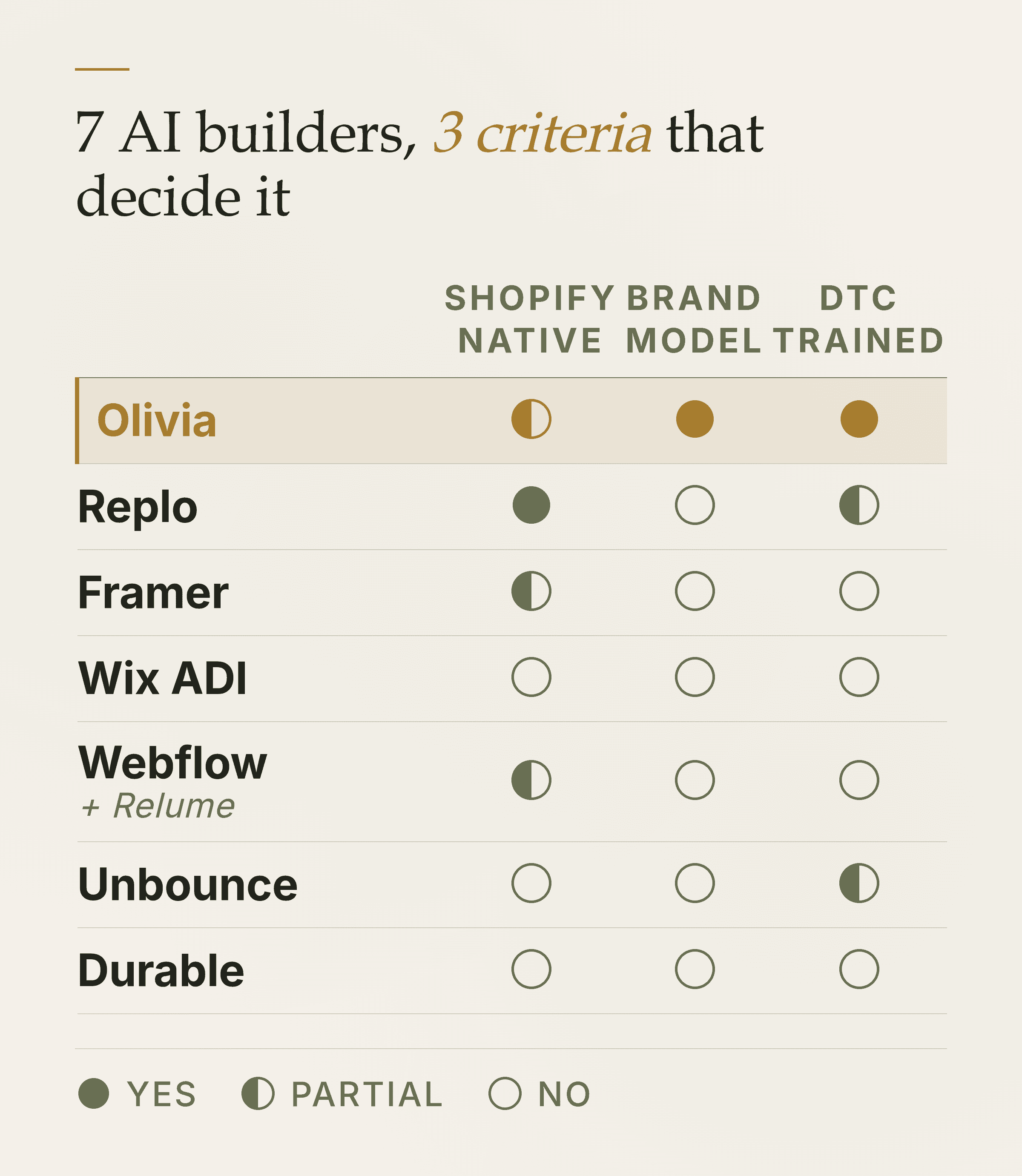
Seven AI website builders scored on the three criteria that decide an ecommerce fit: Shopify-native, persistent brand model, DTC training.
Tool | Shopify | Brand model | DTC-trained |
|---|---|---|---|
Olivia | Native* | Yes | Yes |
Replo | Native | No | Partial |
Framer | Plugin | No | No |
Wix ADI | No | No | No |
Webflow | Plugin | No | No |
Unbounce | No cart | No | Partial |
Durable | No | No | No |
*Olivia exports natively to Shopify for the live creative stack today; page design is on the near-term roadmap. Webflow is paired with Relume throughout.
What to Look for in an AI Website Builder for Ecommerce
Most AI website builder roundups treat every site type the same. For DTC operators, the evaluation criteria are different. Here is what actually matters.
Brand Consistency: Persistent vs. Per-Session
The most underrated differentiator in this category is whether the tool has a persistent brand model. Most AI builders require you to re-enter your colors, fonts, and logo every time you start a new project.
For a DTC brand running 10+ campaigns a year, re-entering brand settings per project is not just annoying — it is a compounding consistency tax. Every session without a persistent model is a session where off-brand outputs slip through.
Olivia's Brand DNA solves this by learning your identity once and applying it to every output forever.
Shopify Integration: Native vs. 'Export to Shopify'
'Export to Shopify' and 'native Shopify integration' are not the same thing. Native integration means product data syncs, pages work with Shopify checkout, and you do not rebuild your commerce setup elsewhere.
Copy-paste code export means you get a file — and then you manually wire it into your store. For product pages and checkout flows, that distinction matters enormously. Replo is the clearest example of a genuinely native Shopify experience on this list. Learn more about Olivia for Shopify once page design ships.
The Creative Asset Pipeline: Pages Are Only Half the Problem
A page builder that does not help you produce the product photos, ad graphics, and email creative that feed the page is solving half the problem. The most efficient DTC stacks connect page design to the broader creative workflow.
For example, Olivia's Brand Audit connects to your Shopify, Meta, and Klaviyo data to surface which pages and creative to prioritize next — so you are not guessing what to build. That kind of data-connected creative direction is absent from every standalone page builder on this list.
Speed vs. Control: Where Do You Sit on the Spectrum?
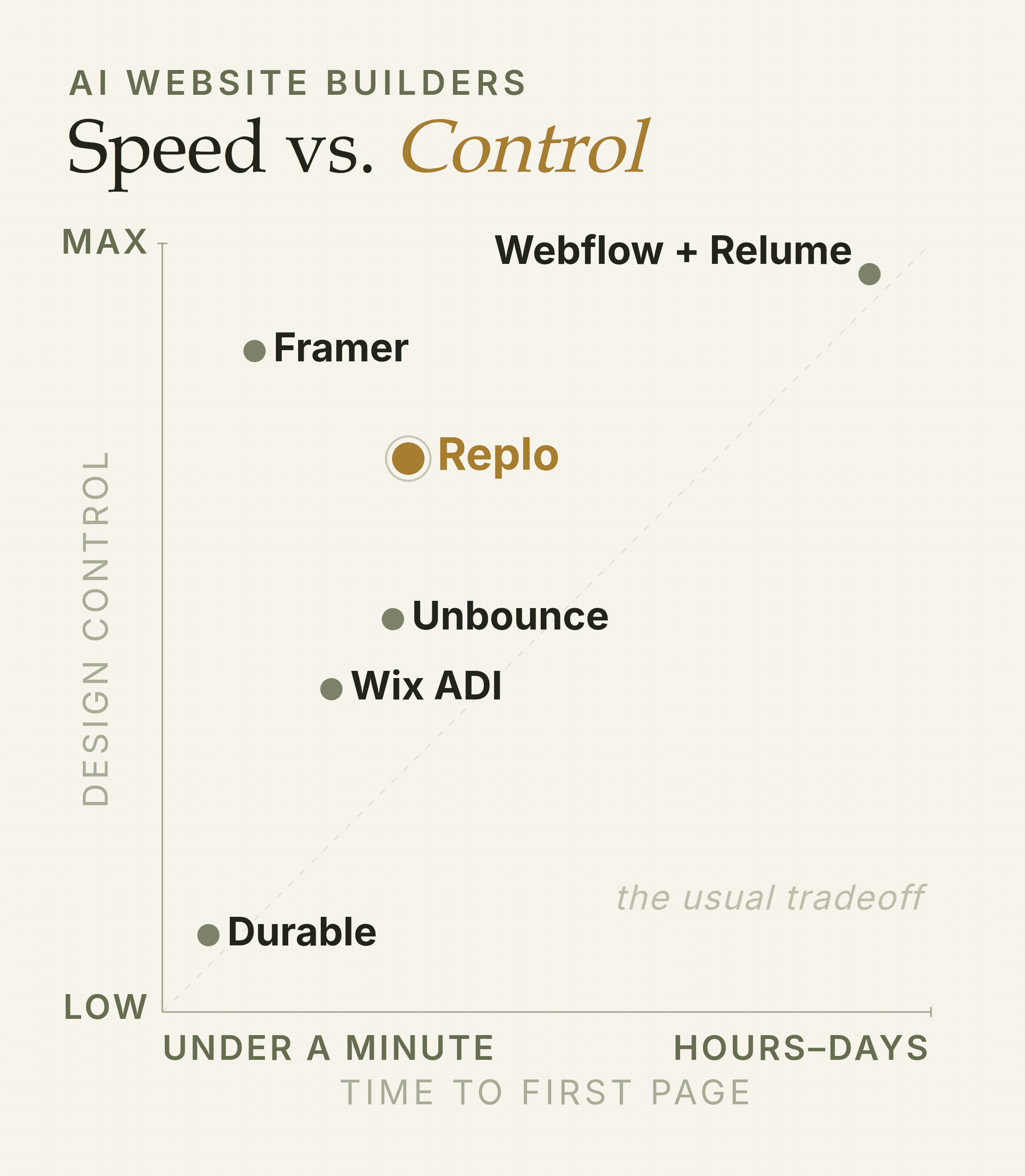
Six builders plotted by time to a first page against design control — Framer and Replo break the usual speed-for-control tradeoff.
Faster tools (Durable, Wix ADI) sacrifice design control. More powerful tools (Webflow, Framer) require more skill and time. Most DTC operators sit in the middle: they need speed, but they also need the output to actually look on-brand.
Tool | First page | Control | Skill |
|---|---|---|---|
Durable | < 1 min | Low | None |
Wix ADI | < 10 min | Medium | Low |
Replo | Minutes | High | Low–Med |
Framer | 60-sec draft | Very high | Med–High |
Webflow | Hours–days | Maximum | High |
Unbounce | Minutes | Medium | Low–Med |
What Does Traditional Web Design Actually Cost in 2026?
Before evaluating any AI tool, anchor on what the traditional alternatives cost. According to current market data, experienced freelance web designers run $75–$150/hr in the US in 2026, with senior practitioners at the higher end.
Freelance web designer: $75–$150/hr for experienced US-based designers; a custom Shopify or Webflow build runs $3,000–$8,000 as a project.
DTC agency site build: $15,000–$75,000+ depending on scope and agency tier.
Ongoing landing page retainer: $3,000–$8,000/mo for a mid-size agency managing active paid traffic campaigns.
AI tools compress these costs dramatically — but only if the tool actually understands ecommerce. A generic AI builder that produces a file you still need a designer to fix does not replace the freelancer; it just adds a step.
The tools on this list that genuinely reduce the design burden are the ones with DTC-specific training, persistent brand models, and native channel export.
Frequently Asked Questions
What is the best AI website builder for Shopify stores?
Replo is the strongest native Shopify landing page builder available today — product data syncs directly and pages work with Shopify checkout. For the full creative stack (photos, ads, email, social, and soon pages), Olivia is the system to build around, with native Shopify export already live for email and design assets.
Can AI website builders create product pages that actually convert?
Yes, but the quality varies significantly. Tools trained on real DTC conversion data — like Replo's DTC-focused templates or Unbounce's Smart Traffic optimization — outperform generic AI builders on conversion. Generic builders produce layouts that look like stores but are not optimized for purchase intent.
Do AI website builders work for DTC brands running paid ads?
The best ones are built for it. Replo generates ad-matched landing pages from a prompt or product link. Unbounce's Smart Traffic AI routes visitors to the best-performing variant automatically, delivering an average 30% lift over standard A/B testing. Generic builders lack this paid-traffic focus.
What's the difference between an AI website builder and an AI landing page builder?
An AI website builder generates full multi-page sites (homepage, about, product pages, blog). An AI landing page builder focuses on single, conversion-focused pages tied to a specific campaign or ad. For DTC paid traffic, a dedicated landing page builder like Replo or Unbounce often outperforms a full website builder on conversion rate.
How much does it cost to build an ecommerce website with AI vs. hiring an agency?
A DTC agency site build runs $15,000–$75,000+ in 2026, and an ongoing landing page retainer runs $3,000–$8,000/mo. AI tools compress this dramatically — but the savings are only real if the tool produces output that does not require a designer to finish. Tools with persistent brand models and DTC-specific training get closest to that bar.
Which AI website builders have native Shopify integration?
Replo is the clearest example of a genuinely native Shopify experience — product data syncs, pages run on Shopify checkout, and there is no need to rebuild your commerce setup.
Framer and Webflow integrate with Shopify via third-party plugins, which works but requires more setup. Olivia has native Shopify export live for email and design assets, with page export on the near-term roadmap.
Bottom Line: Which AI Website Builder Is Right for Your DTC Brand?
The right tool depends on where you are in your stack. If you are on Shopify and need a live landing page today, Replo is the fastest path. If you are design-forward and building campaign microsites, Framer delivers the best output quality.
If you are running heavy paid traffic and need conversion optimization built in, Unbounce is the right call.
If you are building a full DTC creative stack — photos, ads, email, social, Amazon, and soon pages — and want one system that learns your brand once and applies it everywhere, Olivia is the system to build around.
The page feature is coming; the rest of the stack is live today. You can also compare Olivia against other design tools to see where it fits your current workflow.
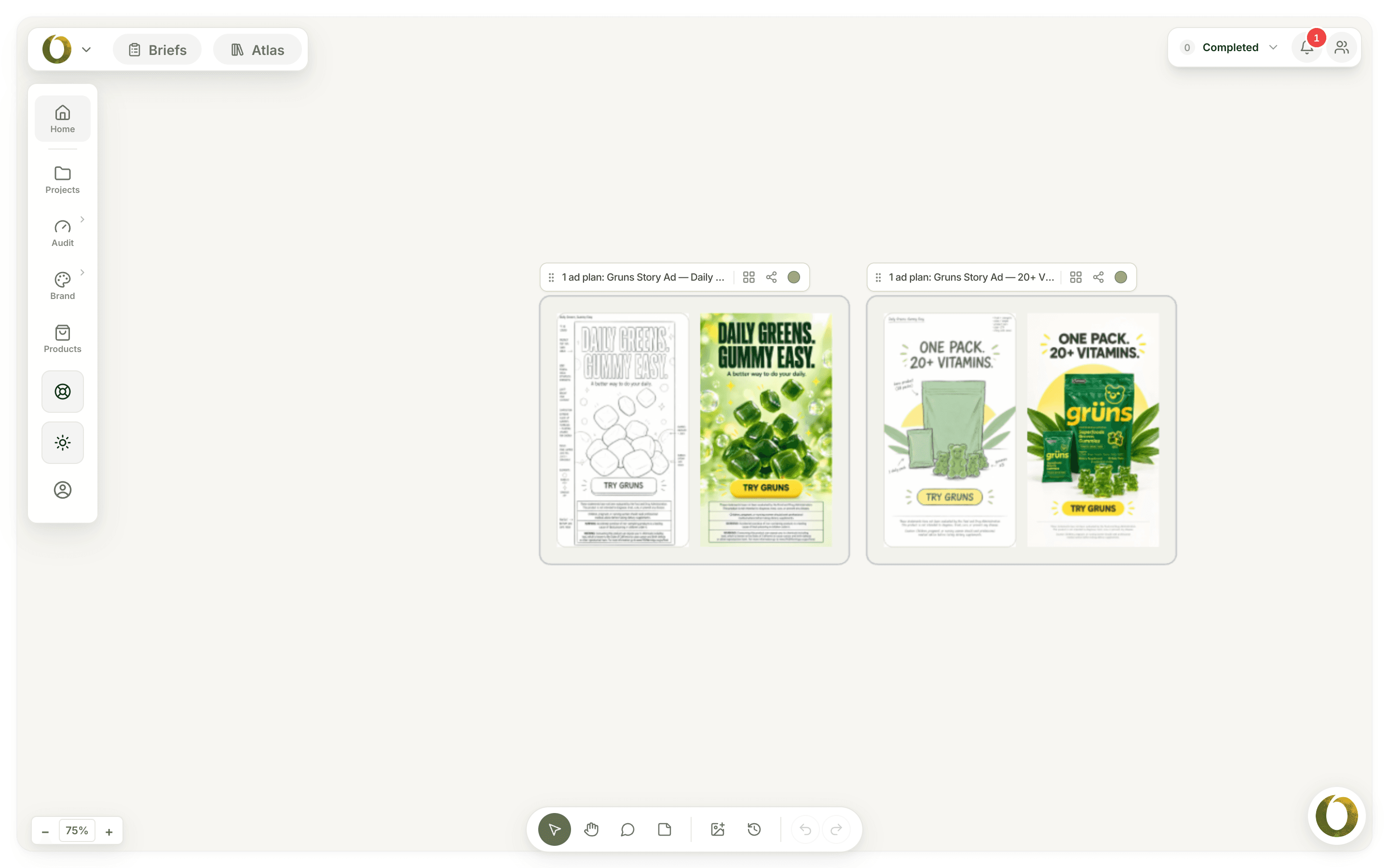
The live half of the stack today: the finished, on-brand 9:16 ad rendered next to the sketch it was approved from.
Need a Shopify landing page now? → Replo
Building a design-forward campaign microsite? → Framer
Running high-volume paid traffic? → Unbounce
Building a custom DTC site with an agency? → Webflow + Relume
Starting from scratch with a small catalog? → Wix ADI
Need a placeholder site in under a minute? → Durable
Want one system for your full DTC creative stack? → Olivia
Not sure which gap in your creative stack is costing you the most? Olivia's free brand and funnel pre-audit researches your brand — site, ads, email, reviews, and competitors — and returns a detailed audit in minutes. No signup required.
Your Store Is Live. Now Fill It. Olivia makes the product photography and ad creative that bring shoppers to the store you just built. Learn more & book a demo