Best Adobe Firefly Alternatives for eCommerce Brands (2026)
Key Takeaways
Adobe Firefly is strong for generative fill inside Photoshop, but it has no persistent brand memory — every session starts from scratch, which is a real cost for DTC teams producing creative at volume.
The most useful adobe firefly alternatives are ranked by DTC workflow fit: brand consistency, product photo accuracy, multi-channel output, and native ecommerce export — not by general image quality.
Only one tool on this list (Olivia) covers the full creative stack — photos, ads, email, social, Amazon, and video — from a single plain-language brief with persistent Brand DNA.
Traditional product photoshoots run $500–$3,000 per photographer day; AI-native tools compress that to minutes at a fraction of the cost, though hero campaign work still benefits from a human lens.
No tool on this list is right for every team — the decision framework at the end maps each tool to the workflow it actually serves best.
The best adobe firefly alternatives for ecommerce are worth evaluating seriously — not because Firefly is bad, but because most DTC operators need more than raw image generation.
Specifically, they need brand consistency across sessions, product-accurate photos, and files that export directly to Klaviyo, Shopify, or Amazon Seller Central without a designer finishing every asset.
In other words, the strongest adobe firefly alternatives solve workflow problems that Firefly simply wasn't built to address.
This list ranks each alternative by how well it serves a DTC operator's full creative workflow — not by brand recognition or feature count. So every tool gets a fair treatment: genuine strengths first, then the gaps that matter for ecommerce.
Why DTC Operators Look Beyond Adobe Firefly
Firefly is genuinely good at what it does. Its commercially safe training data, excellent generative fill, and tight Photoshop integration make it a strong tool for background replacement, product isolation, and lifestyle scene generation. In addition, Adobe Express adds template-based design on top of that generation layer.
Where Firefly falls short for DTC ecommerce workflows:
No persistent brand memory — every session starts from scratch; your logo, colors, and photography style must be re-entered each time.
No native ecommerce export — files don't push directly to Klaviyo, Shopify, or Amazon Seller Central.
No email or ad layout generation — Firefly generates images, not finished ad creative or email flows.
Output typically needs a designer pass — generative fill is a starting point, not a finished asset.
Batch generation is clunky — batch workflows require Photoshop actions or scripts, not a purpose-built DTC pipeline.
The core issue isn't image quality — it's workflow fit. DTC operators need a tool that learns their brand once and applies it across every format automatically.
In other words, Firefly is a creative tool you operate, not an agent that works for you. That's precisely why so many teams explore adobe firefly alternatives built specifically for ecommerce.

Re-briefing every session shows up as drift: same product, six slightly different brands.
How We Evaluated These Alternatives
We scored each tool on five criteria that reflect what a DTC operator actually needs — not general image quality alone. Because workflow fit matters more than raw output, each criterion maps directly to a real production bottleneck.
Brand consistency — Does it remember your identity (logo, colors, type, photography style) across sessions, or do you re-brief it every time?
Product photo accuracy — Does it render product text, packaging, and details faithfully, or does it hallucinate and require cleanup?
Multi-channel output — Does it cover more than one format (ads, email, social, Amazon), or is it single-format?
Export readiness — Are files platform-correct and production-ready without a designer pass?
DTC/ecommerce specificity — Is it trained on or purpose-built for physical-product brands, or is it a general-purpose model?
The Best Adobe Firefly Alternatives for eCommerce in 2026
The tools below are ordered from most to least purpose-built for DTC ecommerce creative workflows. Each gets a genuine strengths summary before any gap is named. Together, they represent the most useful adobe firefly alternatives available to DTC teams right now.
1. Olivia — Best for Full-Stack DTC Creative
Olivia is the only tool on this list purpose-trained on 10,000+ top DTC brands (Olivia 1.0) and built to cover the entire creative stack from a single plain-language brief.
That stack includes AI product photography for DTC brands, ad creative, email flows, social calendars, Amazon listings, and motion/video. As a result, it functions as a full creative department — not just an image generator.
The key differentiator is Brand DNA setup: you upload your brand kit once — logo, colors, typography, photography style, and tone — and every output across every channel inherits it automatically. So unlike Firefly or Midjourney, Olivia requires no re-briefing per session.
That persistent memory is what separates it from every other adobe firefly alternative on this list.

One brief, no re-briefing: the product and brand styling come from Brand DNA, and three directions come back.
What Olivia's AI product photography actually delivers:
Multiple angles and 12 lighting presets from a single product upload — no physical shoot required.
~90% of outputs are production-ready with no designer touch-up, per Olivia's own production data.
True alpha-channel transparency (PNG/WebP) for compositing directly into ads or email templates.
3 minutes vs. 3 weeks compared to traditional agency or photoshoot timelines.
Beyond generation, Olivia connects to Shopify, Meta, Google Ads, Google Analytics, and Klaviyo to run a monthly Brand Audit of your full funnel. It also surfaces pre-specced creative briefs based on what's actually selling — so it functions as a creative strategy layer, not just a generation tool.
Finished assets export natively to Klaviyo and Shopify. Platform-correct downloads are also available for Meta, TikTok, Google, and Amazon Seller Central. For AI ad creative for Meta and TikTok, Olivia generates 500+ on-brand variations per session.
Honest fit note: Olivia is purpose-built for DTC brands selling physical products and the agencies that serve them. If you're a SaaS company or need a general-purpose design suite, it's not the right tool. The onboarding is capped at 80 brands a month — so every brand gets a full audit.
Before committing, you can run a free brand audit — no signup required. Olivia researches your site, reviews, press, and category, then returns a detailed funnel pre-audit. It's the lowest-friction way to evaluate fit.
See What Olivia Finds in Your Funnel Get a free automated pre-audit of your brand — Olivia reviews your site, ads, email, and category, then returns a prioritized creative roadmap. No signup needed to start. Start my free audit
2. Canva — Best for Teams That Need Templates Fast
Canva is the most accessible design platform on the market. Its Magic Studio suite — Magic Design, Magic Write, Magic Eraser, Dream Lab image generation — integrates deeply into the design workflow.
By 2026, Canva reported over 265 million monthly active users, and the April 2026 Canva AI 2.0 preview added agentic tools for recurring design tasks.
Where Canva falls short for high-volume DTC creative:
No persistent brand model — Brand Kit stores assets, but it doesn't train a model on them; every generation is general-purpose.
No product photography depth — Magic Studio generates serviceable images, but it's not trained on DTC product accuracy.
No native Klaviyo or Amazon export — assets download as files; there's no direct channel push.
Template dependency — without deliberate customization, outputs can look like every other Canva post in your category.
Best for: Brands that need fast social graphics, templated email headers, and presentation decks — especially non-designer teams. However, for high-volume, on-brand product creative across multiple channels, Canva's general-purpose model is the ceiling. See how it compares in detail on Olivia vs. Canva.
3. Midjourney — Best for High-Quality Lifestyle Imagery
Midjourney produces some of the best aesthetic imagery of any AI model available. For lifestyle photography, mood boards, and editorial backgrounds, it's genuinely best-in-class. Furthermore, its active community means an enormous library of style references and techniques that teams can draw on immediately.
Where Midjourney falls short for DTC ecommerce:
No brand memory — every prompt starts from scratch; there's no persistent identity layer.
Inconsistent on product text and packaging — notoriously unreliable on labels, SKU text, and product details.
Discord-only interface — adds friction for teams not already living in Discord.
No email, ad, or social layout generation — image-only output with no channel export.
Best for: Creative directors who want inspiration imagery or lifestyle backgrounds and have a designer to composite the final asset. For a deeper comparison, see Olivia vs. Midjourney.
4. Adobe Firefly / Express — Best for Existing Adobe Users
Firefly's commercially safe training data is its most important technical differentiator. As one review notes, it's "the better fit when product imagery is one part of a broad creative workflow" — especially for exploration, Adobe app handoff, and documented training provenance. Generative fill and background replacement inside Photoshop are, as a result, genuinely excellent.
Where Firefly falls short as a standalone DTC tool:
Tool-driven, not brief-driven — you operate Firefly; it doesn't brief itself based on what's selling.
No persistent brand model — brand consistency requires a manually maintained prompt library.
No email or ad layout generation — image generation only, no finished creative.
Output needs a designer finishing pass — generative fill is a starting point, not a production-ready asset.
Best for: Brands already deep in the Adobe ecosystem who need generative fill and background work inside Photoshop. For a direct comparison of the two approaches, see Olivia vs. Adobe.
5. Soona — Best for UGC and Studio-Style Product Photos
Soona is a real-studio-plus-AI hybrid. Users ship products to a studio, join a live shoot remotely, and receive edited assets within 24–72 hours. Its AI Studio then adds lifestyle scene generation and background editing on top of that human-reviewed output. For brands that want a photographer's eye on every asset, that's a meaningful quality floor.
Where Soona falls short for full-stack DTC creative:
Single-format focus — photography and UGC only; no ad, email, social, or Amazon layout generation.
Slower turnaround — 24–72 hours vs. minutes for fully automated AI tools.
No brand memory for multi-channel creative — the studio model doesn't persist a brand identity across formats.
Physical logistics — you still ship products to a studio, which adds lead time and coordination.
Best for: Brands that specifically need UGC-style or human-reviewed product photography and aren't trying to replace their full creative stack. Soona is also worth considering for brands where product texture or detail accuracy is non-negotiable.
6. Typeface — Best for Enterprise Brand Content at Scale
Typeface is a serious enterprise platform. It orchestrates AI agents, brand intelligence, and workflows, enabling businesses to produce personalized and consistent campaigns. Its compliance controls, approval workflows, and integrations with Workfront, AEM, and Salesforce make it well-suited for large marketing teams with strict governance requirements.
Where Typeface falls short for lean DTC teams:
Enterprise-focused onboarding — setup complexity and custom pricing are designed for large organizations, not lean DTC operators.
Not specialized in product photography — broader content focus rather than DTC visual creative depth.
No Amazon or ecommerce channel export — built for marketing content at scale, not platform-specific DTC formats.
Overkill for most DTC brands — the governance and approval infrastructure is valuable at enterprise scale, not at a 10-person DTC brand.
Best for: Larger organizations — retail groups, multi-brand portfolios, enterprise marketing teams — that need brand-compliant content generation across marketing and internal comms. As a result, it's not the right fit for lean DTC teams optimizing for creative volume and speed.
Side-by-Side: Adobe Firefly Alternatives for eCommerce
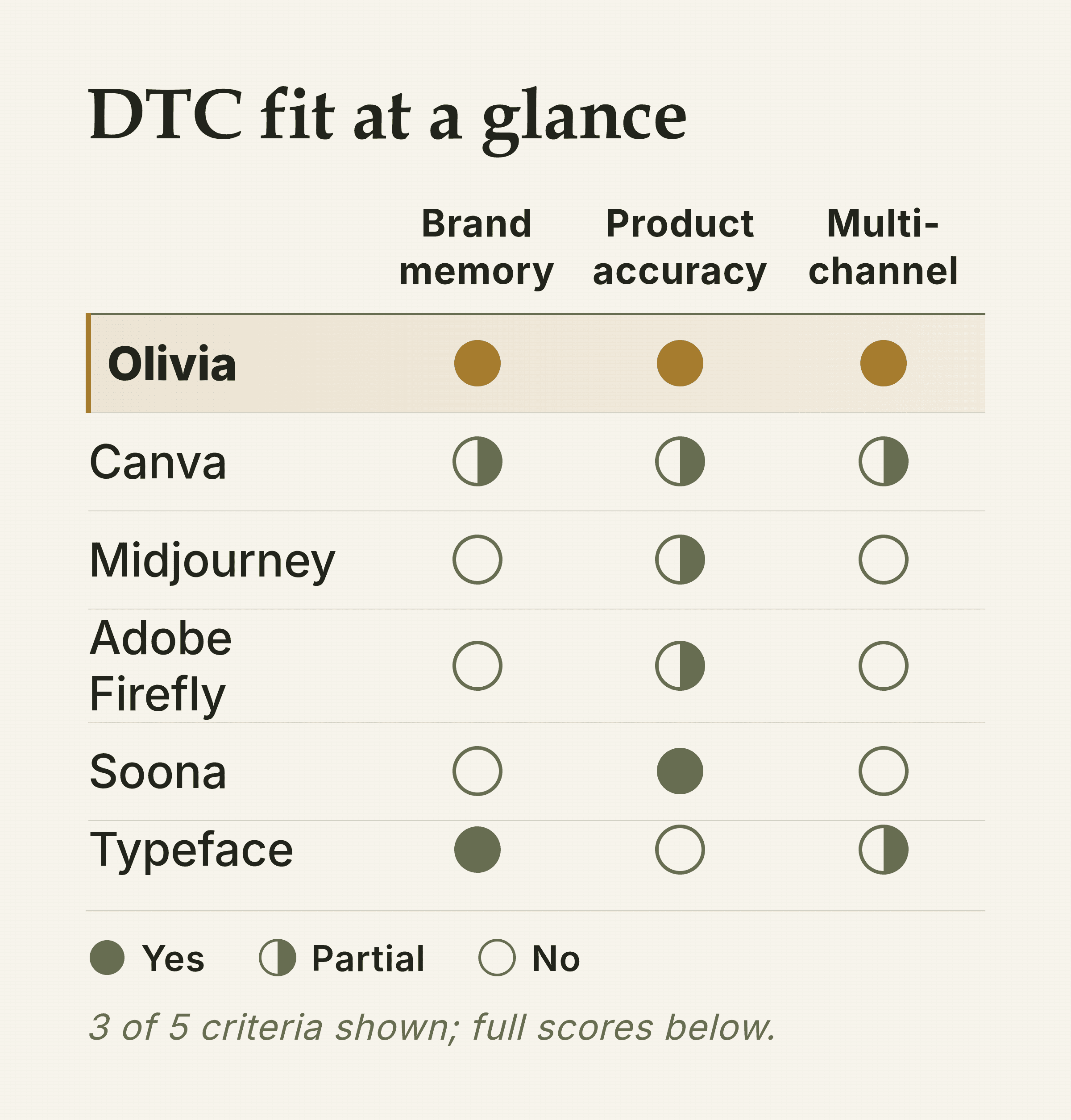
Only one tool fills every dot; the full five-criteria breakdown follows.
The table below uses the five evaluation criteria from the framework section. Ratings are honest — no inflation for Olivia, no deflation for competitors where they genuinely deliver.
Adobe Firefly Alternatives: DTC Ecommerce Scorecard — Olivia
Brand Memory: Yes
Product Accuracy: Yes (~90%)
Multi-Channel: Yes (all)
eCommerce Export: Yes (native)
DTC-Trained: Yes
Canva
Brand Memory: Partial
Product Accuracy: Partial
Multi-Channel: Partial
eCommerce Export: No
DTC-Trained: No
Midjourney
Brand Memory: No
Product Accuracy: Partial
Multi-Channel: No
eCommerce Export: No
DTC-Trained: No
Adobe Firefly
Brand Memory: No
Product Accuracy: Partial
Multi-Channel: No
eCommerce Export: No
DTC-Trained: No
Soona
Brand Memory: No
Product Accuracy: Yes (studio)
Multi-Channel: No
eCommerce Export: No
DTC-Trained: No
Typeface
Brand Memory: Yes
Product Accuracy: No
Multi-Channel: Partial
eCommerce Export: No
DTC-Trained: No
The table's sharpest insight: Olivia is the only tool that scores Yes across all five criteria. Every other tool on this list scores No or Partial on at least three. For DTC operators who need the full stack, that gap is not close.
Which Tool Is Right for Your Workflow?
The right tool depends on what you're actually trying to replace. Here's a quick map:
Full DTC creative stack (photos, ads, email, social, Amazon) with persistent brand memory → Olivia
Fast templated social graphics for a non-technical team → Canva
High-quality lifestyle imagery with a designer to finish assets → Midjourney
Generative fill inside Photoshop for an Adobe-ecosystem team → Firefly / Express
UGC or studio-reviewed product photos with human oversight → Soona
Enterprise brand content with complex approval workflows → Typeface
The cost context: Traditional product photoshoots run $500–$3,000 per photographer day, and agency creative retainers typically run $5,000–$15,000 per month. AI-native tools compress that to minutes at a fraction of the cost. However, hero campaign work — brand-defining editorial, complex textures, press imagery — still benefits from a human lens.
For more context on the AI image editing landscape, see Best AI Image Editors for DTC Brands in 2026 and Best Generative AI Platforms for DTC Brands (2026) — both cover overlapping tools with different evaluation lenses.
Frequently Asked Questions
Is Adobe Firefly good for ecommerce product photography?
Firefly is useful for background replacement, generative fill, and lifestyle scene generation inside Photoshop. However, it lacks persistent brand memory, and batch generation is clunky. As a result, output typically needs a designer pass before it's channel-ready. So for brands that need high-volume, on-brand product photos across a catalog, a purpose-built tool will be more efficient.
What is the best AI tool for DTC brand creative in 2026?
For full-stack DTC creative — product photography, ads, email, social, Amazon, and video — Olivia is the most purpose-built option. It's the only tool on this list trained specifically on DTC brands (Olivia 1.0, 10,000+ brands).
As a result, it's also the only one that covers every channel from a single brief with persistent Brand DNA. In other words, it's the most complete adobe firefly alternative for ecommerce teams.
Can AI tools replace a product photographer for Shopify brands?
For catalog and ad creative, yes — AI tools handle roughly 80–95% of ecommerce product imagery cleanly and at a fraction of traditional photoshoot costs.
However, the exception is hero campaign work: brand-defining editorial, highly transparent fabrics, complex jewelry detail, and press imagery still benefit from a human photographer. So the practical answer is that AI handles volume, while humans handle hero.
What's the difference between Midjourney and Adobe Firefly for product images?
Midjourney produces higher aesthetic quality for lifestyle and editorial imagery. However, it is notoriously inconsistent on product text, labels, and packaging details. Firefly, by contrast, integrates tightly with Photoshop for generative fill and background replacement but has no persistent brand memory. As a result, neither tool is purpose-built for DTC product photography at catalog scale.
Do any AI design tools integrate natively with Klaviyo or Shopify?
Olivia exports finished email designs natively into Klaviyo and Shopify — no HTML copy-paste or template rebuilding required. No other tool on this list offers a native Klaviyo push.
For Shopify product photography and store design, Olivia also connects directly to your store data. Because of that direct integration, it's the strongest adobe firefly alternative for teams running Klaviyo-driven email programs.
Which Adobe Firefly alternative works best for Amazon listing images?
Olivia is the only tool on this list with a dedicated Amazon design feature — trained on 10,000+ top-selling listings, it generates full listing image sets, A+ Basic/Premium content, and brand stores in Amazon Seller Central's exact required specs.
Other tools produce general images that require manual resizing and formatting for Amazon. So if Amazon is a priority channel, Olivia is the clear choice.
The Bottom Line on Adobe Firefly Alternatives
Firefly is a strong tool for Adobe-ecosystem teams doing generative fill and background work inside Photoshop.
However, for DTC operators who need brand-consistent creative across photos, ads, email, social, and Amazon — without re-briefing a model every session — it's not built for that job. That's why evaluating adobe firefly alternatives purpose-built for ecommerce is worth the time.
The tools on this list each win a specific use case. For full-stack DTC creative from a single brief, Olivia is the most purpose-built adobe firefly alternative available. For a no-commitment evaluation, the free brand audit is the fastest way to see what it finds in your funnel.
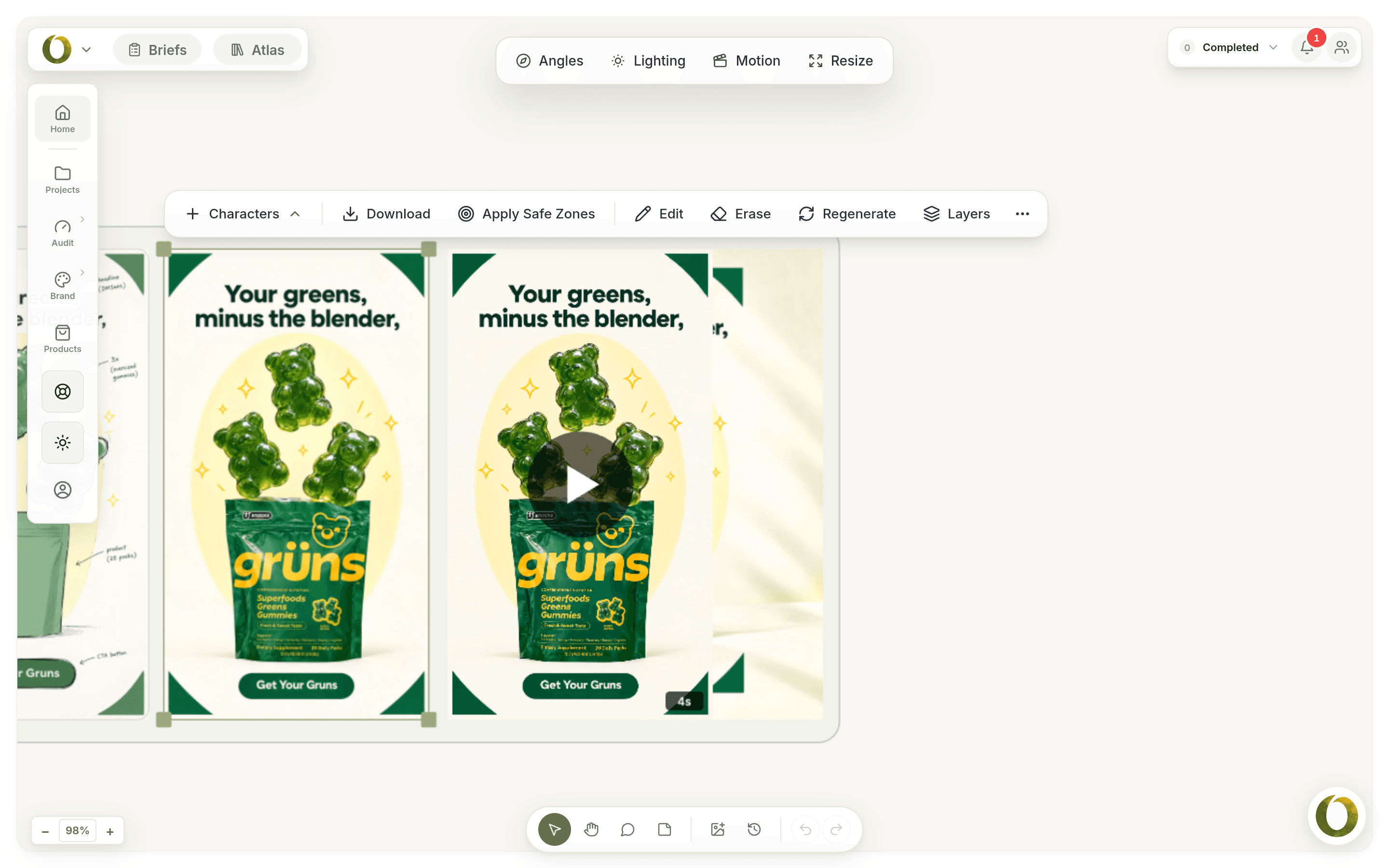
Story, motion and feed from one brief, each ready to download in platform specs.
Also worth reading: Best AI Design Assistants for DTC Brands in 2026 covers the broader AI design assistant category, and Best AI Image Enhancers for Product Photos in 2026 digs into post-production tools for brands that shoot traditionally.
Get Your Free DTC Creative Audit Olivia reviews your site, live ads, email flows, and category — then returns a prioritized roadmap of what to make next. Free, automated, no designer required. Start my free audit