Best AI Headshot Generators in 2026 (Ranked & Compared)
Key Takeaways
The best AI headshot tool depends entirely on your job-to-be-done: solo LinkedIn photo, team portraits at scale, or a full DTC creative stack — these are three different problems.
Aragon AI leads for individual likeness accuracy; HeadshotPro is the clearest choice for team headshots at scale with SOC 2 compliance and bulk-invite workflows.
Olivia is not a headshot tool — it's a DTC AI design agent. It earns its top-tier placement for ecommerce operators because it extends from product photography into ads, email, social, Amazon, and video in one system with persistent Brand DNA.
Traditional individual headshot sessions run $150–$500+; a product photoshoot day rate runs $1,000–$5,000+. AI tools collapse both to minutes, but a real photographer still wins for C-suite portraits and complex multi-person shoots.
Recruiters correctly identify AI headshots only about 40% of the time — and in blind comparisons, 76.5% actually prefer them. The real risk is a photo that doesn't look like you, not the technology itself.
An AI headshot generator used to be a novelty — blurry faces, plastic skin, obvious tells.
In 2026, the best tools produce portraits that recruiters correctly identify as AI only 40% of the time, and in blind tests, 76.5% of hiring managers actually prefer them.
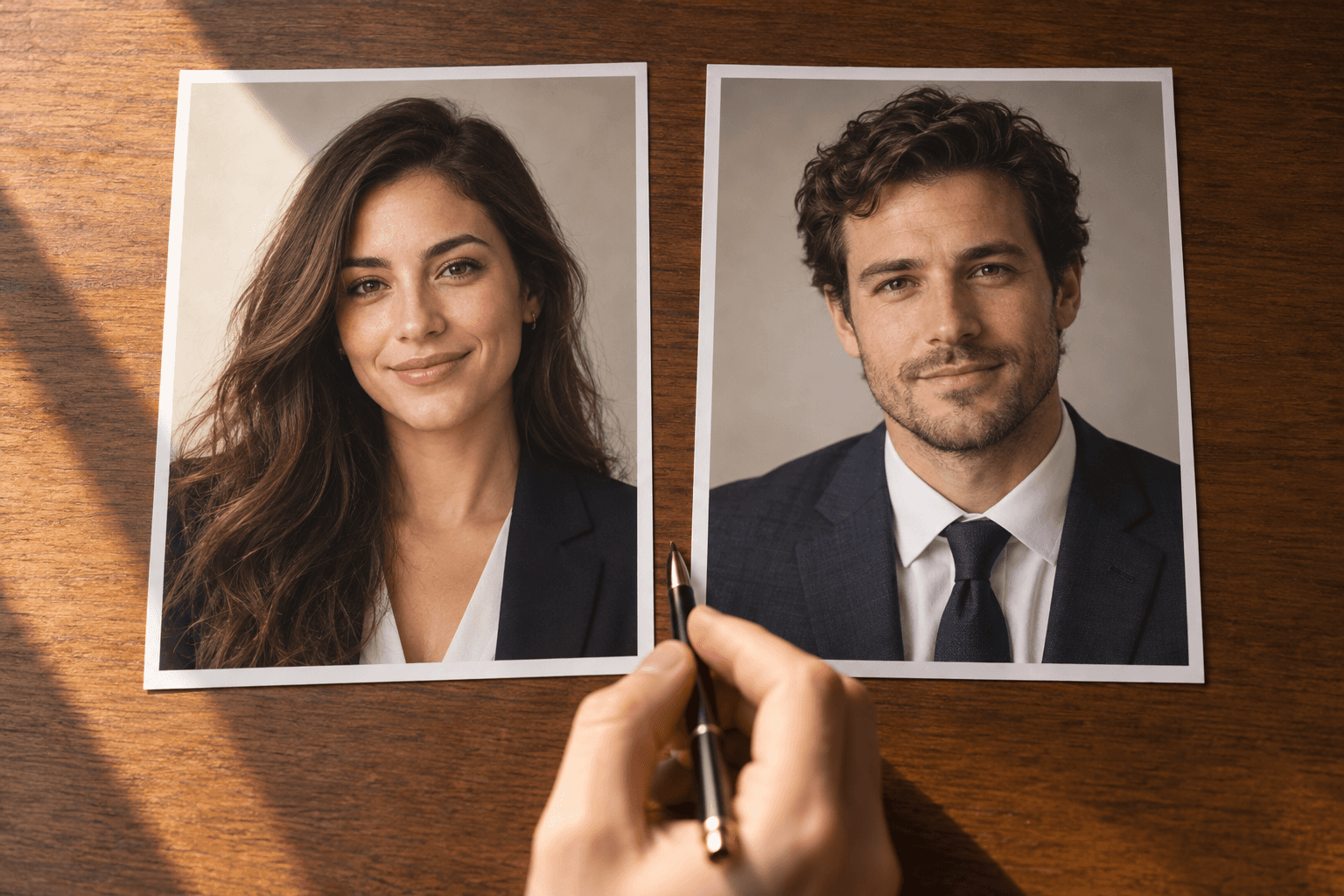
In 2026, recruiters correctly spot an AI headshot only about 40% of the time.
The real question is no longer "does AI work?" — it's "which tool is right for my actual use case?"
This guide makes one split that most roundups skip: pure headshot tools (built for individual portraits) vs. tools that extend into brand and product creative (built for operators and teams). If you need a LinkedIn photo, jump to Aragon AI or HeadshotPro.
If you run a DTC brand or ecommerce store and need product photography, ads, and email too, jump to Olivia.
How We Evaluated These Tools
Every tool in this list was evaluated on five criteria. Each one maps to a real decision a buyer has to make.
Likeness accuracy — does the output actually look like the person or product?
Turnaround time — minutes, hours, or days from upload to download?
Output formats and download specs — platform-correct files, or raw exports you have to resize yourself?
Brand/style consistency — does the tool remember your identity across sessions, or start from scratch every time?
Scope — headshot only, or does it extend to product photos, ads, email, and video?
Scope matters more than it looks. Many readers start with "I need a headshot" and quickly realize they also need product photos, ad creative, or email assets. A single-format tool is fine for individuals. A tool that handles the whole creative stack is better for operators.
Quick Comparison: AI Headshot Generators at a Glance
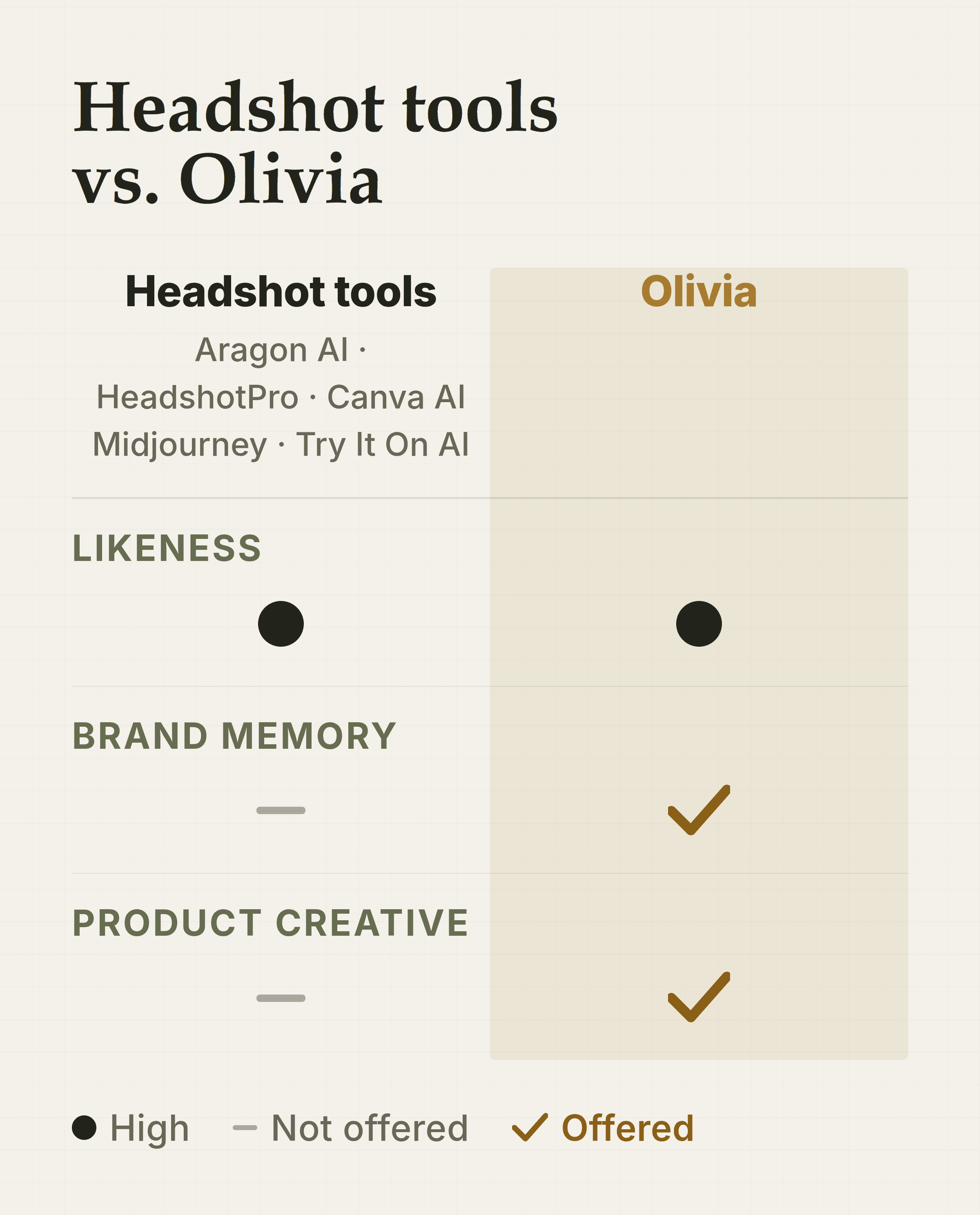
Likeness is table stakes; brand memory and product scope are where the tools split.
AI Headshot Generator Comparison (2026) — Olivia
Best For: DTC brands & ecommerce teams
Likeness Accuracy: ~90% production-ready (product)
Brand Memory: Persistent — learned once, forever
Aragon AI
Best For: Individual portraits (LinkedIn)
Likeness Accuracy: High — 4.9/5 Trustpilot
Brand Memory: None — per-session only
HeadshotPro
Best For: Team headshots at scale
Likeness Accuracy: Good — SOC 2, bulk workflow
Brand Memory: None — per-session only
Canva AI
Best For: Quick portrait, existing Canva users
Likeness Accuracy: Moderate — template-driven
Brand Memory: None
Midjourney
Best For: Artistic / editorial portraits
Likeness Accuracy: Variable — prompt-dependent
Brand Memory: None — per-prompt only
Try It On AI
Best For: Budget individual headshots
Likeness Accuracy: Good for the price
Brand Memory: None
The Best AI Headshot Generators, Ranked
Rankings reflect the criteria above. Olivia earns the top slot for DTC operators and ecommerce teams — but not for solo portraits. For individual LinkedIn headshots, Aragon AI and HeadshotPro are genuinely better choices. This list says so plainly.
1. Olivia — Best for DTC Brands and Ecommerce Teams
Olivia is not a pure headshot tool — and that's the point. It's the world's first DTC AI design agent, custom-trained on 10,000+ top DTC brands. For ecommerce operators, it earns its top placement because it extends from AI product photography for DTC brands into ads, email, social, Amazon, and video in one system.
The differentiating feature is Brand DNA: upload your brand kit once — logo, colors, typography, photography style, tone — and every output inherits it automatically, forever. No re-briefing per session. No style drift between a product photo and an email header.
How Olivia's Brand DNA works is the clearest example of persistent brand memory in this category.
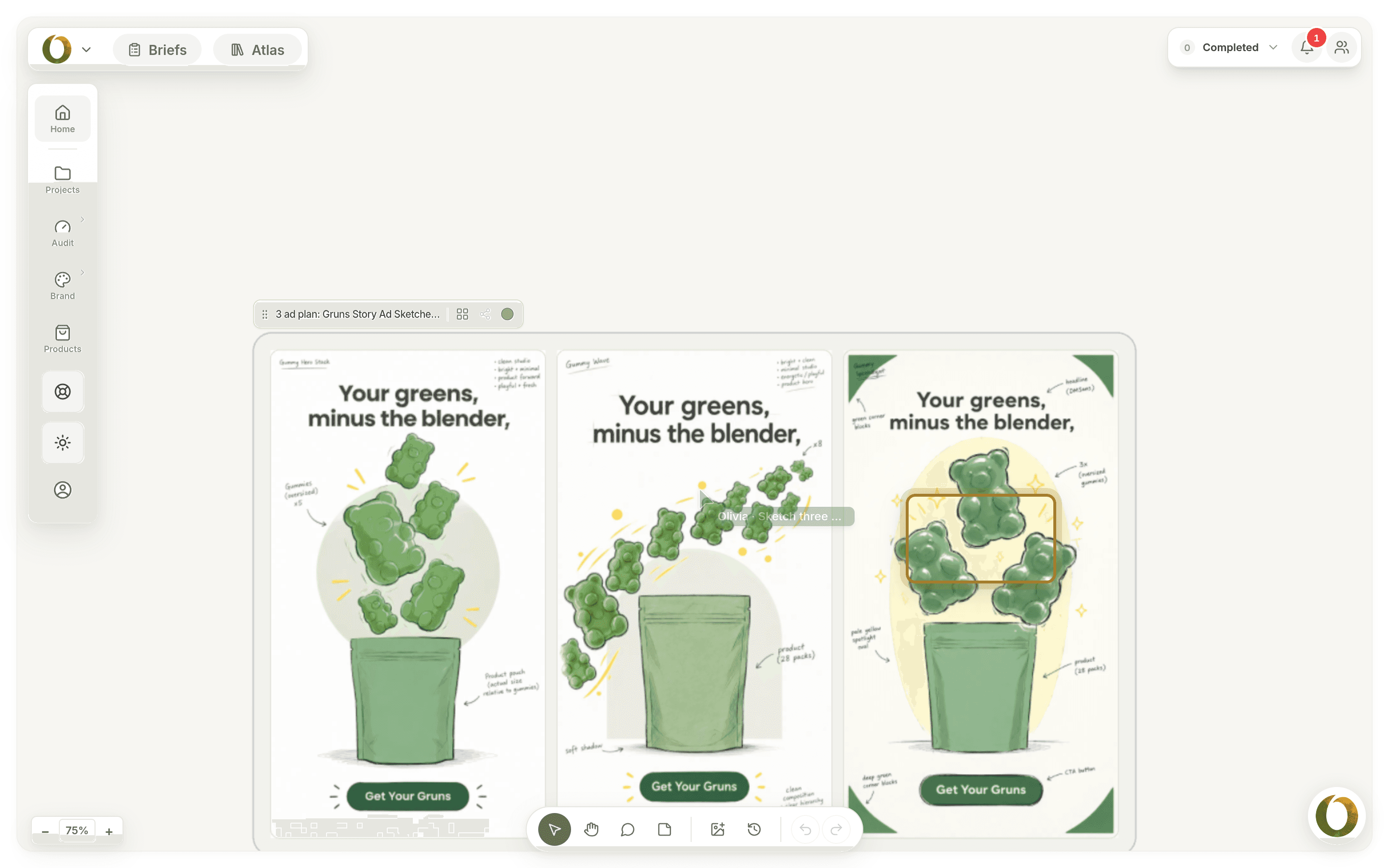
Brand DNA in practice: one brief, three directions, one brand identity, with no re-briefing.
AI Product Photography specifics:
From one product image, Olivia generates multiple angles and 12 lighting presets in minutes
~90% of outputs are production-ready with no designer touch-up required
3 minutes vs. 3 weeks compared to a traditional agency cycle
Transparent-background PNG/WebP output for direct compositing into ads or email
Beyond photography, Olivia connects to Shopify, Meta, Google Ads, and Klaviyo. Its Brand Audit reads your full funnel monthly and surfaces pre-specced creative briefs — specific ad sets, email flows, or photo series grounded in what's actually selling. That's a different category from a headshot tool.
The honest limitation: if you need a personal LinkedIn headshot and have no brand or product to photograph, Olivia is overkill. A dedicated headshot tool is simpler and cheaper for solo portraits. Olivia is purpose-built for operators who need a high volume of on-brand creative across every channel — not one photo.
Olivia is backed by Google for Startups, AWS Activate, and the NVIDIA Inception Program. Onboarding is capped at 80 brands a month.
DTC operators can start with a free automated pre-audit — a 7-question quiz that returns a detailed funnel analysis before any commitment. Get your free brand audit for your ecommerce store to see where your creative gaps actually are.
See What Your DTC Creative Stack Is Missing Olivia audits your full funnel — store, ads, email, and brand presence — and returns a detailed pre-audit with specific creative gaps and a prioritized roadmap. Free, automated, no signup required. Start my free audit
2. Aragon AI — Best Pure Headshot Tool for Individuals
For a solo LinkedIn refresh or resume headshot, Aragon AI is the strongest dedicated option. It produced the most consistently realistic headshots in 2026 retesting — natural skin tones, proper lighting, and believable backgrounds without the over-smoothed "AI look." It holds a 4.9 out of 5 on Trustpilot from more than 5,800 reviews.
Aragon delivers the fastest turnaround — 15 to 45 minutes — and the lowest input requirement, just 6 selfies, in the entire category. Its onboarding is the most guided of any tool tested: you answer questions about hair, ethnicity, body shape, and outfit preference before uploading.
Aragon AI at a glance:
Strengths: Highest likeness accuracy for individuals, fast turnaround, strong privacy posture
Limitations: Headshots only — no brand memory, no product photography, no channel export
Best for: Professionals, job seekers, and founders who need a polished LinkedIn or resume photo fast
3. HeadshotPro — Best for Team Headshots at Scale
HeadshotPro is the best AI headshot generator for teams and businesses in 2026. Its dashboard handles bulk invites and shared style presets so everyone matches. An admin can invite 100 employees, and each receives matching headshots without ever leaving their desk.
If your security team needs SOC 2, SAML SSO, and a REST + webhook API, HeadshotPro is the most credible AI vendor in the category. It trains a custom AI model on 10–15 selfies you upload, then generates a batch of headshots in your chosen styles within about 2 hours.
HeadshotPro at a glance:
Strengths: Bulk invite workflow, shared style presets, SOC 2 compliance, team discounts
Limitations: Portrait-only scope, no brand creative extension, no product photography
Best for: HR teams, companies onboarding new hires, or any org that needs consistent headshots across 10–1,000 people
4. Canva AI — Best for Simple, Template-Driven Portraits
Canva's Magic Studio includes an AI headshot generator — it offers two free credits to create professional AI headshots, with a 24-hour wait before generating more for free. For existing Canva users who need a quick portrait without leaving their design workflow, it's a zero-friction option.
However, Canva is a general-purpose design tool. It has no persistent brand model, no product-photo depth, and no native channel export for ecommerce. For DTC brands, it's a starting point — not a production system. See how it compares to a purpose-built DTC tool in our best AI design assistants for DTC brands roundup.
Canva AI at a glance:
Strengths: Familiar interface, free tier, wide template library, accessible for non-designers
Limitations: Not DTC-trained, no persistent brand model, no product-photo depth, no native ecommerce export
Best for: Existing Canva subscribers who need a quick single portrait without switching tools
5. Midjourney — Best for Creative and Artistic Portrait Work
Midjourney (now on V8.1 as of mid-2026) produces the most visually stunning AI portraits available. Its Omni Reference feature lets you upload a portrait that Midjourney uses as a visual anchor — bringing it the closest it has ever been to a true likeness-based workflow for headshots.
But Midjourney is not a headshot tool in the traditional sense. Portraits look professional at thumbnail size; zoom in and you may notice slightly off proportions or a dreamlike quality. Every session starts from scratch — there is no brand memory, no product accuracy guarantees, and no native channel export.
Midjourney at a glance:
Strengths: Exceptional image quality and artistic range, Omni Reference for near-likeness control, active community
Limitations: Requires prompt engineering, no brand memory, output often needs a post-production pass, no ecommerce export
Best for: Creative professionals and designers who want artistic, editorial-quality portraits and are comfortable with prompt-based workflows
6. Try It On AI — Best Budget Option for Quick Headshots
Try It On AI offers the lowest price-per-headshot of any dedicated tool in the category. It generates professional studio-quality headshots in about 2 minutes from 1 selfie and is trusted by 3 million+ professionals at companies including Google and Goldman Sachs.
For individuals on a tight budget who need a fast, decent LinkedIn photo, it's a solid choice. However, style control is limited compared to Aragon AI, and — like every other headshot tool in this list — it has no brand or product creative scope.
Try It On AI at a glance:
Strengths: Very low barrier to entry, fast turnaround, good for individuals on a budget
Limitations: Limited style control, portrait-only, no brand or product creative scope
Best for: Individuals who need a quick, affordable headshot and don't need multiple styles or brand consistency
AI Headshot vs. Real Photoshoot: What's the Actual Difference?
The cost gap is not close. A standard headshot session in most major US cities runs $300–$500; budget photographers in smaller cities start at $150–$250; executive or editorial photographers charge $1,500–$5,000+. That's just the session fee — retouching, travel, and scheduling add more.
AI vs. Traditional Photography: Key Differences — Individual headshot cost
Traditional Shoot: $150–$500+ per session
AI Tool: Fraction of that cost
Product shoot day rate
Traditional Shoot: $1,000–$5,000+ per day
AI Tool: Minutes, no day rate
Turnaround
Traditional Shoot: 2–4 weeks (agency)
AI Tool: 3 minutes to 2 hours
Revision cycles
Traditional Shoot: Reshoot = rebook
AI Tool: Regenerate instantly
Brand memory
Traditional Shoot: Photographer's notes
AI Tool: Persistent (Olivia only)
For DTC brands specifically, product photography at scale is where AI creates the biggest leverage. Traditional product photography averages $85–$250 per SKU when you factor in studio rental, prop styling, and post-production retouching. For a brand launching 200 new SKUs per season with three images each, that's $51,000–$150,000 per cycle — before reshoots.
The DTC math: a single photoshoot can't produce 500 ad variations. A seasonal refresh can't wait 3 weeks for a new batch of images.
AI tools — especially purpose-built ones like Olivia's AI product photography — change the cost structure from a high-cost event to a continuous workflow. That's the real advantage, not just the per-image price.
AI still has real limits. The art direction, lighting control, and post-production of a professional shoot can't be replicated by any AI tool yet. Complex multi-person shoots, specific physical environments, and UGC authenticity all favor a real photographer.
For C-suite portraits where the photo will represent a leader for years, a traditional photographer is still recommended because AI struggles to replicate the nuanced expression and custom lighting that senior leaders require.
Which AI Headshot Tool Is Right for You?
The best tool is the one that matches your actual scope. Don't pay for a full creative stack if you need one LinkedIn photo. Equally, don't use a headshot-only tool if you need product photos, ads, and email too.
Use this to route yourself:
Personal LinkedIn or resume headshot → Aragon AI (best likeness accuracy) or Try It On AI (best budget option)
Team headshots at scale, with compliance requirements → HeadshotPro (bulk invites, SOC 2, shared presets)
Artistic or editorial portrait work, comfortable with prompting → Midjourney (Omni Reference for near-likeness control)
Quick portrait inside a design tool you already use → Canva AI (free tier, zero friction)
Product photography, ad creative, email, social, and Amazon for a DTC brand or ecommerce store → Olivia (the only tool here that extends from photography into a full DTC creative stack)
For DTC operators specifically: Olivia's free pre-audit is the lowest-friction entry point. Answer 7 questions and get a detailed analysis of your funnel — customer profiles, ad ideas, email gaps, and a prioritized creative roadmap — before any commitment. It's the fastest way to see whether your current creative stack has gaps worth closing.
If you're evaluating the broader AI creative landscape, also see our comparisons of the best AI image editors for DTC brands and the best generative AI platforms for DTC brands — both cover overlapping tools with different lenses.
Get a Free Audit of Your Ecommerce Creative Olivia reviews your store, ads, email, and brand presence — then returns a detailed pre-audit: customer profiles, ad ideas, PDP findings, and a prioritized roadmap of what to make next. Start my free audit
Frequently Asked Questions
Are AI headshots good enough for professional use in 2026?
Yes, for most professional use cases. Top tools like Aragon AI and HeadshotPro produce results that are indistinguishable from studio photography at LinkedIn thumbnail size.
The key rule: the photo must actually look like you. A technically polished AI headshot that doesn't match your real appearance creates a trust problem at the interview — not a photography problem.
Can employers or recruiters tell if a headshot was AI-generated?
Rarely. Multiple studies in 2025–2026 found that recruiters correctly identify AI headshots only about 40% of the time — below random chance. In blind comparisons, 76.5% of recruiters actually preferred AI headshots on professionalism and approachability.
The real risk is a photo that doesn't look like you, not the technology itself.
How many photos do I need to upload to get a good AI headshot?
Most dedicated tools require 6–20 selfies. Aragon AI works from as few as 6. HeadshotPro recommends 10–15 for best results.
Quality of input matters more than quantity: varied angles, good natural lighting, no sunglasses or hats, and a mix of expressions will outperform 30 identical selfies.
What's the difference between an AI headshot generator and an AI product photography tool?
An AI headshot generator is trained on human portraits — it takes selfies and returns professional-looking photos of a person. An AI product photography tool is trained on product images — it takes a photo of an object and generates studio-quality shots across angles, lighting, and backgrounds.
Olivia is the only tool in this list that does both, plus ads, email, social, and Amazon creative — purpose-built for DTC brands.
Do AI headshot tools work for team or company-wide headshots?
Yes — HeadshotPro is purpose-built for this. An admin sends bulk invites, each team member uploads their own selfies, and the tool generates consistent, matching headshots across the whole team.
For companies with compliance requirements, HeadshotPro offers SOC 2 certification and SAML SSO.
Can I use an AI headshot tool for ecommerce product photos?
Standard AI headshot tools are trained on human portraits and are not designed for product photography — the output quality for objects is poor.
For ecommerce product photos, use a purpose-built tool. Olivia generates multiple angles and 12 lighting presets from one product image, with ~90% production-ready output and native export to Shopify, Klaviyo, and Amazon Seller Central.