Best AI Website Tools for DTC Brands (2026)
Key takeaways
Most AI website tools are built for general businesses — they don't know your brand, don't connect to Shopify, and produce pages that look nothing like your ads or emails.
The five criteria that actually matter for DTC: brand consistency, ecommerce fit, production-readiness, channel integration, and briefing experience — not drag-and-drop ease.
Replo is the strongest standalone Shopify landing page builder today; Framer wins on visual polish for brand sites; Webflow gives design teams the most control.
Olivia is the only system that learns your Brand DNA once and applies it across every live creative channel — photos, ads, email, social, Amazon, and video — with native Shopify and Klaviyo export. Landing and website page design is on the roadmap but not yet shipped.
A landing page that doesn't match your ad creative breaks trust before the visitor reads a word — creative consistency from ad click to checkout is the real conversion lever.
The best AI website tool for a DTC brand depends on what you actually need: a Shopify-native landing page builder, a polished standalone site, or a full creative system that keeps every page, ad, and email visually consistent.
This article evaluates six tools through a DTC lens — brand consistency, ecommerce fit, production-readiness, channel integration, and briefing experience — so you can match the right tool to your real use case.
What to look for in an AI website tool as a DTC brand
General-purpose AI site builders solve a general problem. They don't know your brand colors, they can't pull your Shopify product data, and they produce a one-off page that looks nothing like your Meta ads or your Klaviyo flows. For DTC operators, that gap is a conversion problem, not just an aesthetic one.
The five criteria used to evaluate every tool in this article:
Brand consistency — does the tool learn your visual identity, or do you re-brief it every session?
DTC/ecommerce fit — does it handle product pages, PDPs, and landing pages built for physical-product funnels?
Production-readiness — how much manual cleanup does the output need before it can go live?
Channel integration — does it connect natively to Shopify, Klaviyo, or Meta, or does it export a static file you have to wire up yourself?
Briefing experience — can a non-designer brief it in plain language, or does it require prompt engineering or design tool expertise?
The best AI website tools for DTC brands in 2026
"AI website tool" covers a wide spectrum — full site builders, Shopify-native landing page generators, and AI creative systems with page design capability. The right pick depends on your use case. Here are six tools evaluated against the criteria above.
1. Olivia — Best for DTC brands that need on-brand creative across every channel
Olivia is a DTC AI design agent trained on 10,000+ top DTC brands. It learns your brand once — logo, colors, typography, photography style, and tone — and applies that Brand DNA to every output it generates, forever. No re-briefing, no template hunting.
Live today: AI product photography for DTC brands, ad creative (500+ on-brand variations per session), AI email design with Klaviyo export, social calendars, Amazon listings, and motion/video. Around 90% of outputs are production-ready with no designer touch-up — versus the typical AI output that needs a full finishing pass.
Important disclosure: Olivia's landing and website page design feature is on the roadmap but not yet shipped. If you need a standalone site builder or Shopify landing page builder today, pair Olivia with one of the tools below.
But for every other creative channel — ads, email, social, photos, Amazon, video — Olivia is the only system that keeps them all on-brand from a single Brand DNA.
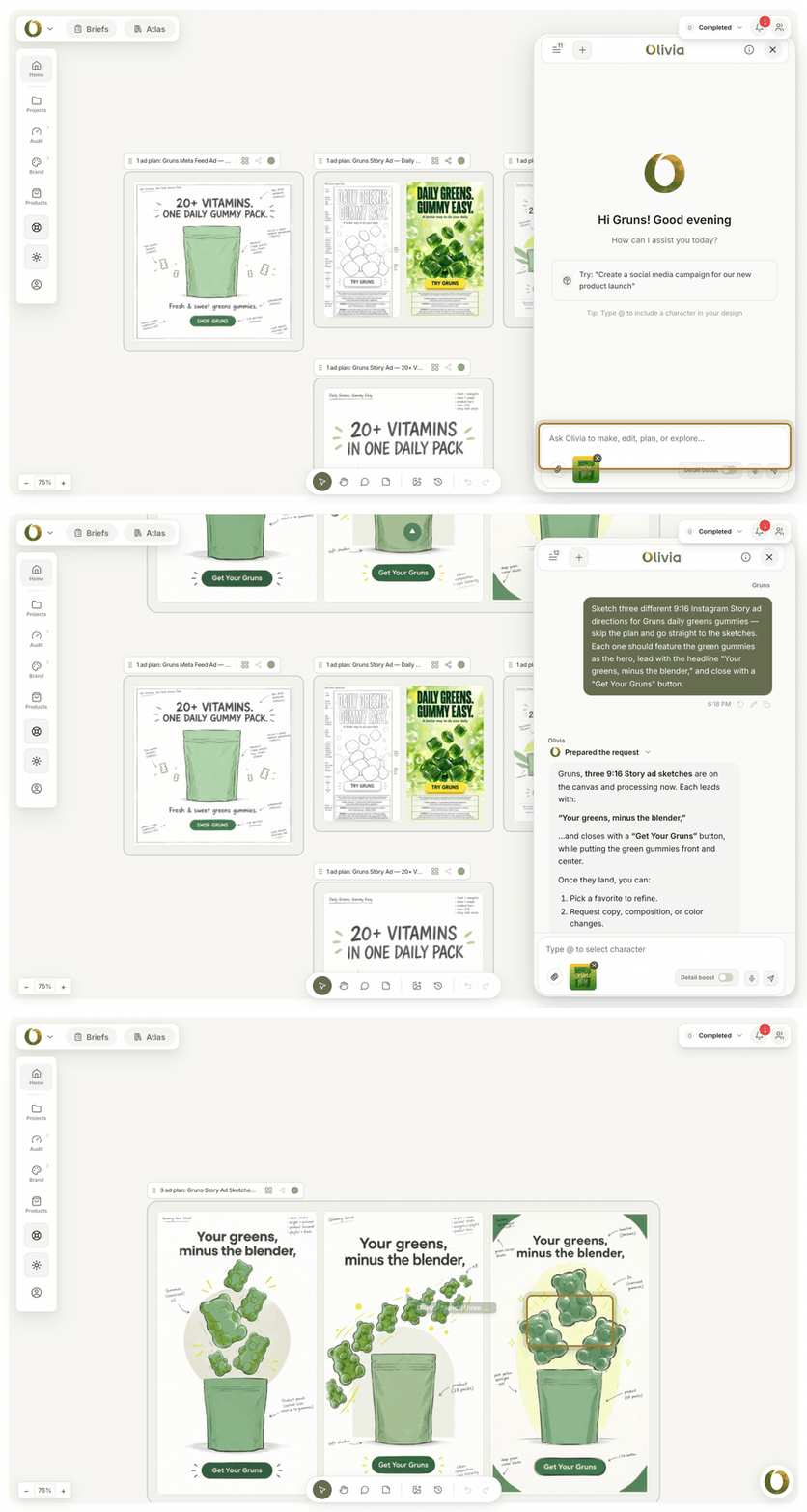
One plain-language brief, three on-brand directions — the layout, type, and colors come from Brand DNA, not from a prompt.
Best for:
DTC operators who need a single system for all their creative — and want landing pages to join that system when the feature ships.
Brands running paid ads who need ads, emails, and product photos to look like the same brand.
Agencies producing high-volume DTC creative for multiple clients, with native Shopify export and Klaviyo handoff built in.
See How Your DTC Funnel Actually Stacks Up Olivia audits your brand — site, ads, email, reviews, and competitors — and returns a detailed funnel pre-audit. Free, automated, no designer required. Start my free audit
2. Framer AI — Best for fast, visually polished standalone sites
Framer is a design-forward AI site builder that generates full websites from a text prompt. Its Figma-style canvas gives designers real control over layouts, typography, and animations — and the AI layer handles the blank-page problem fast.
DTC fit: Framer handles selling through third-party integrations like Shopify rather than a native store engine. For a handful of hero products or a campaign landing page, that works fine. For a large catalog or a PDP-heavy DTC store, it's the wrong foundation.
Best for:
DTC brands that need a beautiful standalone marketing site or campaign page quickly.
Teams with a designer who can finalize the AI-generated output.
Brand storytelling pages and campaign microsites where visual quality is the priority.
3. Webflow AI — Best for teams that want design control plus CMS
Webflow's AI Site Builder generates a multi-page starter site from a prompt — sitemap, design system, and layouts — inside the Webflow Designer. As of 2026, Webflow positions itself as an "agentic web marketing platform," with AI credits included across paid plans.
DTC fit: Webflow's ecommerce layer is better suited for smaller catalogs than high-volume DTC retail. There's no persistent brand memory across sessions, and Shopify integration requires workarounds. However, for teams with a dedicated designer or developer, Webflow's CMS depth and developer handoff are genuinely strong.
Best for:
DTC brands with a dedicated web designer or developer who needs fine-grained control.
Marketing teams that own the website and need to launch landing pages without filing dev tickets.
Brands that need a robust CMS for content-heavy pages alongside their ecommerce stack.
4. Replo — Best for Shopify landing pages and CRO
Replo is a Shopify-native landing page builder with AI-assisted copy and layout generation. It's purpose-built for paid-traffic teams: the AI generates ad-matched landing pages from a prompt or a product link, and Shopify product data syncs directly into the builder.
DTC fit: Strong Shopify integration with built-in A/B testing and analytics. However, Replo's AI features are more copy and layout assist than full generative design — there's no persistent brand memory across sessions, and it doesn't produce ad creative, email, or product photography.
Best for:
DTC brands on Shopify that need fast, CRO-focused landing pages and PDPs without leaving the Shopify ecosystem.
Paid-traffic teams running high-volume ad campaigns who need ad-matched landing pages quickly.
Brands that want built-in A/B testing and analytics on their landing pages.
5. Canva AI (Magic Studio) — Best for teams already in Canva
Canva's Magic Studio brings AI image generation, Magic Design, and text-to-design templates to a tool most DTC teams already use. The learning curve is low and the output is fast.
DTC fit: Canva is not DTC-trained. Its Brand Kit requires manual re-application each session — there's no persistent brand model. There's also no native Shopify or Klaviyo export, and output typically needs a designer pass for production use on paid channels.
Best for:
Small DTC teams or agencies that already live in Canva and need quick, template-based pages alongside other Canva work.
Social graphics and simple marketing pages where DTC-specific training depth isn't required.
Teams with a designer who can do the final production pass before assets go live.
6. Durable — Best for very early-stage brands that need a site in minutes
Durable generates a complete small-business website in roughly 30 seconds from a business description. It's the fastest path from zero to a live URL — no design skills, no configuration.
DTC fit: Durable lacks product catalogs, shopping carts, inventory management, and payment integrations. It's not designed for ecommerce. For a DTC brand at any meaningful scale, Durable is a placeholder, not a stack.
Best for:
Early-stage DTC founders who need a placeholder site live in minutes before investing in a proper stack.
Brands validating a concept before committing to Shopify or a full site build.
Non-technical founders who want a basic web presence with CRM and invoicing in one place.
Head-to-head: how these AI website tools stack up for DTC
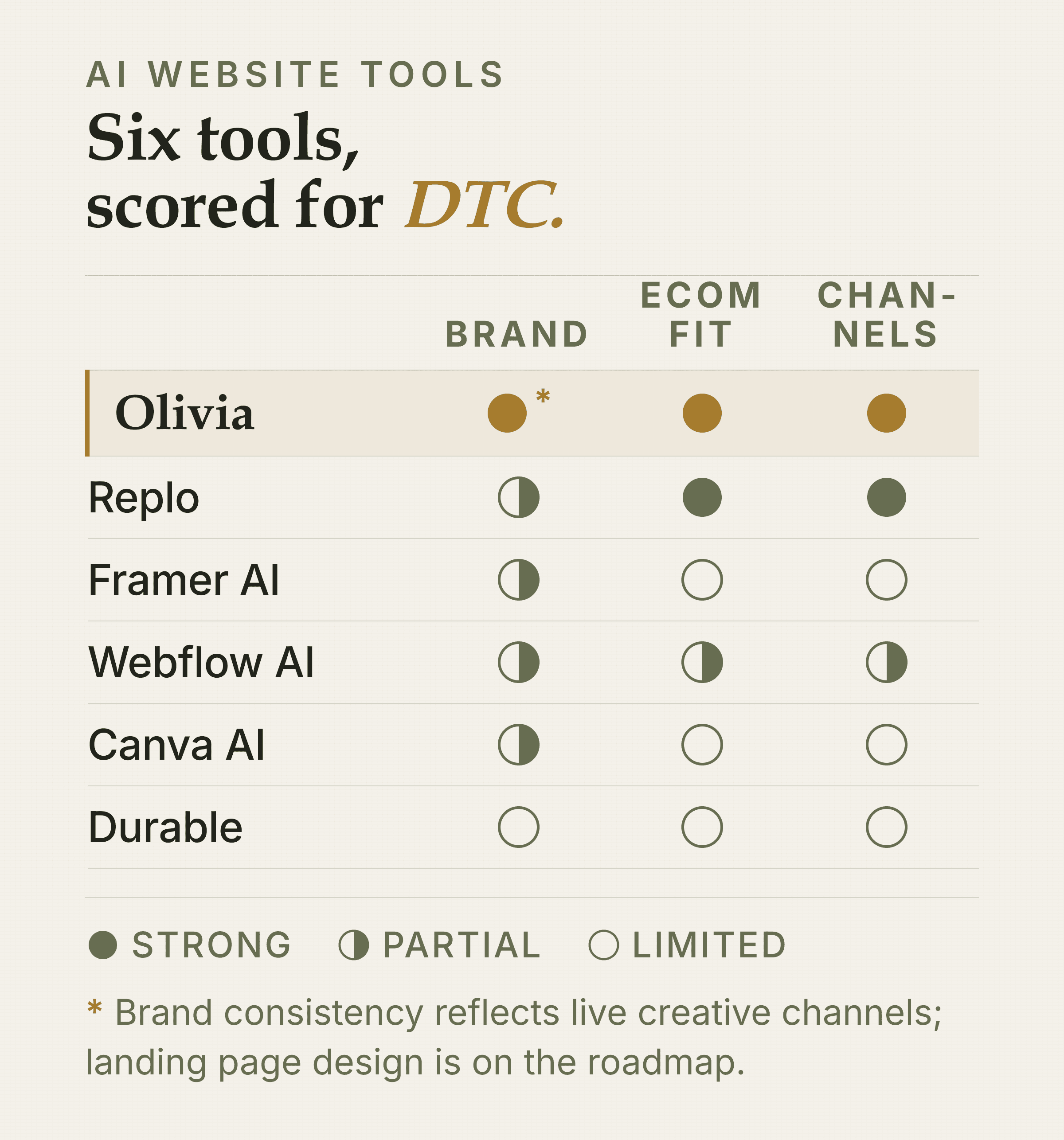
The table below uses three ratings: Strong (a genuine capability), Partial (works with caveats or manual steps), and Limited (not a core strength). Note that Olivia's Brand Consistency and Channel Integration scores reflect its live creative capabilities — the landing page feature is planned, not shipped.
AI website tools for DTC — comparison table — Olivia
Brand Consistency: Strong*
DTC/Ecom Fit: Strong
Production-Ready: Strong (~90%)
Channel Integration: Strong (Shopify, Klaviyo, Meta)
Replo
Brand Consistency: Partial
DTC/Ecom Fit: Strong (Shopify)
Production-Ready: Partial
Channel Integration: Strong (Shopify native)
Framer AI
Brand Consistency: Partial
DTC/Ecom Fit: Limited
Production-Ready: Partial
Channel Integration: Limited (3rd-party only)
Webflow AI
Brand Consistency: Partial
DTC/Ecom Fit: Partial
Production-Ready: Partial
Channel Integration: Partial (workarounds)
Canva AI
Brand Consistency: Partial
DTC/Ecom Fit: Limited
Production-Ready: Partial
Channel Integration: Limited (no native export)
Durable
Brand Consistency: Limited
DTC/Ecom Fit: Limited
Production-Ready: Partial
Channel Integration: Limited
The DTC creative consistency problem — and why it kills conversions
Most AI website tool reviews miss the DTC-specific problem: a landing page that doesn't match your ad creative breaks trust before the visitor reads a word. The click comes from a Meta ad. The page has to feel like the same brand — same photography style, same color palette, same tone.
The math on mismatch: When your ad and landing page tell two different visual stories, users form opinions in seconds.
Research shows 74% of visitor attention goes to what's above the fold — and a tone or visual mismatch there is enough to spike bounce rates and signal low purchase intent to Meta's algorithm, raising your CPA over time.
What the traditional creative stack actually costs
The traditional approach to DTC creative consistency involves multiple vendors: a product photoshoot, a freelance designer, and a CRO agency — each producing assets that may or may not match each other.
Traditional DTC creative costs vs. AI-native alternative — Product photoshoot
Traditional cost: $2,000–$5,000+ per shoot
AI-native alternative: Minutes, from one product image
Freelance designer
Traditional cost: $65–$150/hr (mid–senior)
AI-native alternative: ~90% production-ready output
CRO agency retainer
Traditional cost: $5,000–$15,000/mo
AI-native alternative: Brand Audit + Briefs, monthly
Time to first asset
Traditional cost: 3+ weeks (agency cycle)
AI-native alternative: ~3 minutes per output
The deeper issue isn't just cost. It's that a photoshoot, a freelance designer, and a CRO agency each work in isolation. So your ads look like one brand, your emails look like another, and your landing page looks like a third.
How Brand DNA solves the consistency problem
Olivia's how Brand DNA works is the structural answer: upload your brand kit once, and every output — ads, emails, product photos, social posts, Amazon listings — inherits your logo, colors, typography, and photography style automatically. No re-briefing, no QA step to check if the new email matches the latest ad.
The Briefs feature extends this further: Olivia reads your connected Shopify, Meta, Google Ads, and Klaviyo data, then proposes specific creative to build next — an ad set, an email flow, a photo series — with the brief already written. You review and hit go. The output is generated in your Brand DNA.
How to choose the right AI website tool for your DTC brand
The right tool depends on what you need to ship today. Here's the plain-language decision framework:
Need a Shopify-native landing page builder today? → Replo. It's purpose-built for paid-traffic landing pages and PDPs, with native Shopify sync and built-in A/B testing.
Need a beautiful standalone brand site or campaign page? → Framer (for visual quality and speed) or Webflow (for CMS depth and developer handoff).
Want one AI system for all your DTC creative — ads, email, social, photos, Amazon, video — with landing pages joining that system when the feature ships? → Olivia. See the products overview for the full live capability set.
Very early stage and just need something live in minutes? → Durable. It's a placeholder, not a long-term stack — but it's genuinely the fastest path to a live URL.
Already living in Canva and need quick template-based pages? → Canva Magic Studio. Just plan for a designer finishing pass before anything goes to paid channels.
The real test: The best AI website tool isn't the one with the most features. It's the one that keeps your brand consistent from ad click to checkout — because that's where conversion actually happens.
For a broader look at the AI tools category, see our roundup of best generative AI platforms for DTC brands and best AI website builders for ecommerce — both cover adjacent tools and use cases in more depth.
See How Your Funnel Stacks Up Before You Pick a Tool Olivia researches your brand — site, ads, email, reviews, and competitors — and returns a detailed pre-audit of your funnel. Free, automated, no credit card. Start my free audit
Frequently asked questions
What is the best AI tool to build a landing page for a Shopify store?
Replo is the strongest Shopify-native landing page builder in 2026. It generates ad-matched landing pages from a prompt or product link, syncs Shopify product data natively, and includes built-in A/B testing.
For brands that also need ads, email, and product photos to match the landing page, Olivia's landing page feature is on the roadmap and will connect to the same Brand DNA.
Can AI build a website that matches my existing brand identity?
Most AI site builders can't — they start from scratch every session. Olivia is the exception for creative channels: it learns your Brand DNA once (logo, colors, type, photography style) and applies it to every output automatically.
For landing and website pages specifically, Olivia's page feature is planned but not yet live. Framer and Webflow can approximate your brand visually, but require manual re-briefing each project.
What's the difference between an AI website builder and an AI design agent?
An AI website builder generates pages — it solves one format. An AI design agent like Olivia covers the full creative stack: product photography, ads, email, social, Amazon, and video, all from a single Brand DNA. The practical difference: a site builder produces a page that may look nothing like your ads; a design agent keeps every channel consistent automatically.
Do I need a designer to use AI website tools, or are outputs production-ready?
It depends on the tool. Most AI site builders (Framer, Webflow, Canva) produce a strong starting point that still needs a designer finishing pass for paid-channel use. Olivia's live creative outputs — ads, email, product photos — are around 90% production-ready with no touch-up required. For the planned landing page feature, production-readiness will follow the same standard.
Which AI tools integrate natively with Shopify and Klaviyo?
Replo integrates natively with Shopify for landing pages. Olivia exports finished email designs natively into both Klaviyo and Shopify, and connects to Shopify store data for its Brand Audit and Briefs features. Most other AI website builders (Framer, Webflow, Canva) require manual export or third-party integrations to connect to Shopify or Klaviyo.
How much does it cost to build a DTC landing page with AI vs. hiring an agency?
Traditional costs: a product photoshoot runs $2,000–$5,000+, a freelance designer charges $65–$150/hr, and a CRO agency retainer costs $5,000–$15,000/month. AI tools compress the time from weeks to minutes and the cost to a fraction of those rates.
Olivia's proof point is ~98% less than agency and freelancer cost per design asset — without quoting a subscription price, the relative saving is the relevant comparison.